
 Scott Bezek
836227d4f6
Generate PCB assembly files
Scott Bezek
836227d4f6
Generate PCB assembly files
|
4 năm trước cách đây | |
|---|---|---|
| .github | 4 năm trước cách đây | |
| .vscode | 4 năm trước cách đây | |
| cad | 4 năm trước cách đây | |
| doc | 4 năm trước cách đây | |
| electronics | 4 năm trước cách đây | |
| firmware | 4 năm trước cách đây | |
| scripts | 4 năm trước cách đây | |
| util | 4 năm trước cách đây | |
| .gitignore | 4 năm trước cách đây | |
| LICENSE.txt | 4 năm trước cách đây | |
| README.md | 4 năm trước cách đây | |
| __init__.py | 4 năm trước cách đây |
README.md
SmartKnob
SmartKnob is an open-source input device with software-configurable endstops and virtual detents.
A brushless gimbal motor is paired with a magnetic encoder to provide closed-loop torque feedback control, making it possible to dynamically create and adjust the feel of detents and endstops.
Designs
SmartKnob View
Premium SmartKnob experience. Under active development.
⚠️ Update (2022-03-24): As a result of the popularity of this project, it seems like the recommended motors are unfortunately no longer available. I expect that these motors are simply no longer in production and therefore limited stock was available (for future reference in case you find them being sold elsewhere at a higher price, they were originally selling for US$2.56 each before this project was published). However... 👇
💡 There is an ongoing search for new motors in issue #16 - follow along there for the latest info (or join in and help us find a good replacement). Any change in motor will likely require substantial redesigns, so don't order PCBs/printed parts until there is more clarity on the motor.
Features:
- 240x240 round LCD ("GC9A01"), protected by 39.5mm watch glass on rotor
- BLDC gimbal motor, with a hollow shaft for mechanically & electrically connecting the LCD
- Powered by ESP32-PICO-V3-02 (Lilygo TMicro32 Plus module)
- PCB flexure and strain gauges used for press detection (haptic feedback provided via the motor)
- 8 side-firing RGB LEDs (SK6812-SIDE-A) illuminate ring around the knob
- USB-C (2.0) connector for 5V power and serial data/programming (CH340)
- VEML7700 ambient light sensor for automatic backlight & LED intensity adjustment
- Versatile back plate for mounting - use either 4x screws, or 2x 3M medium Command strips (with cutouts for accessing removal tabs after installation)
- Front cover snaps on for easy access to the PCB
Current status: Not recommended for general use (mechanical and electrical revisions are planned)
Demo video
<img src="https://img.youtube.com/vi/ip641WmY4pA/maxresdefault.jpg" width="480" />
3D CAD
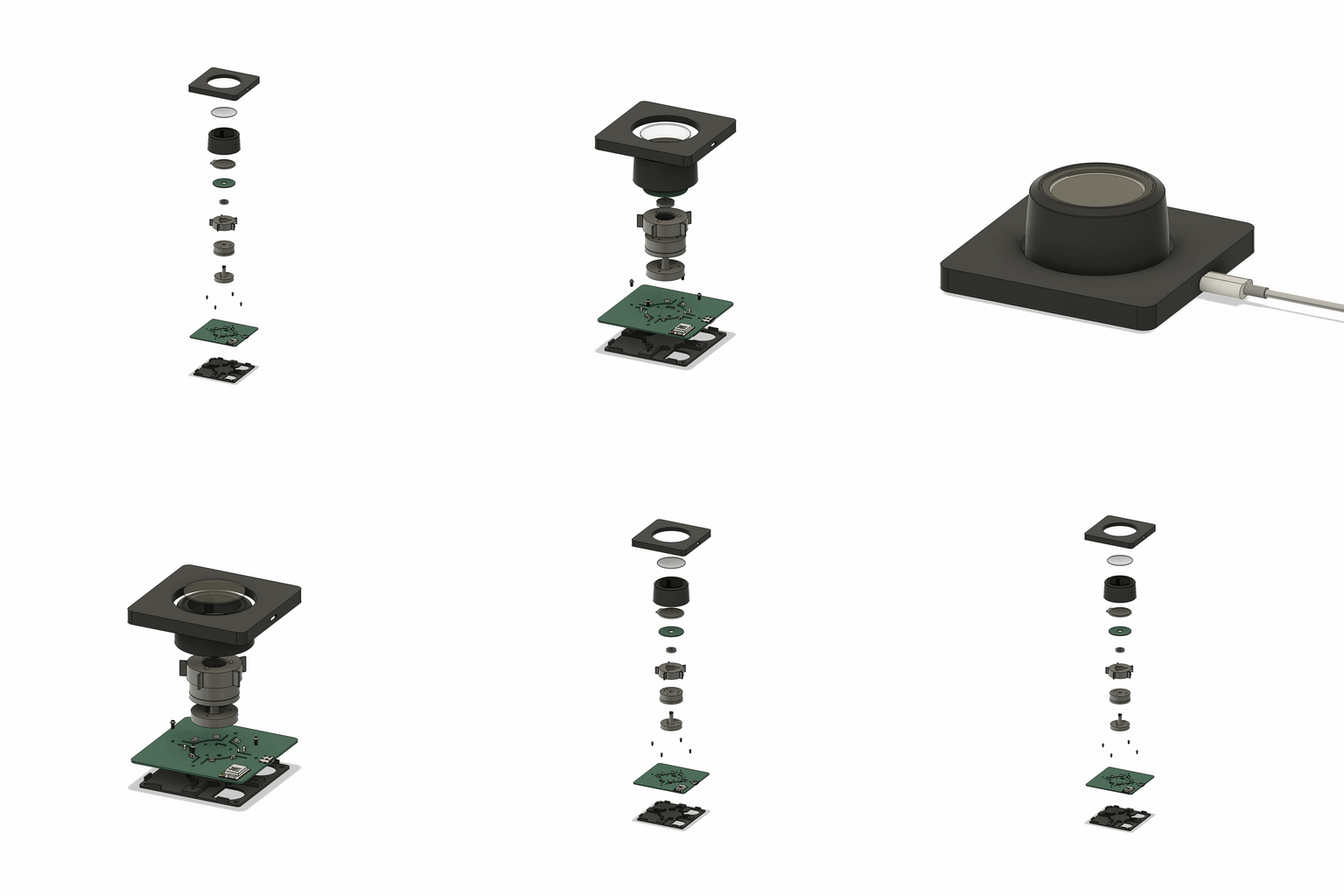
Latest Fusion 360 Model: https://a360.co/3BzkU0n
Build your own?
While this is a "DIY" open-source project, it is not yet a mature plug-and-play project. If you intend to build your own, note that it requires advanced soldering experience to build - very small-pitch surface-mount soldering is required (reflow or hot air recommended), and assembly is quite time-consuming and delicate. Please go into it with the expectation that you will almost certainly need to be able to troubleshoot some hardware and firmware issues yourself - I recommend reviewing/understanding the schematics and basic firmware before jumping in!
More documentation on the BOM and what parts you need to order is coming in the future - thanks so much for your interest! Follow me on Twitter for the latest updates on this and other projects.
View the latest auto-generated (untested) Base PCB Interactive BOM and Screen PCB Interactive BOM (or, the combined BOM csv) for electronics/hardware parts list. ⚠️ These are auto-generated from the latest untested revision on GitHub. For tested/stable/recommended artifacts, use a release instead.
A few miscellaneous notes in the meantime:
- This can probably be FDM 3D printed with a well-tuned printer, but the parts shown in videos/photos were MJF printed in nylon for tight tolerances and better surface finish
- If you wanted a simpler build, you could omit the LCD and just merge the knob + glass from the model into a single STL to get a closed-top knob
- There's limited space inside the LCD mount for wiring, and 8 wires need to fit through the hole in the center. I used 30 AWG wire-wrapping wire. Enamel-coated wire would probably work too.
- Strain gauges are BF350-3AA, and glued in place with CA glue (I'll include video of this process in the future, but essentially I used kapton tape to pick up the strain gauge and hold it in place during curing). This has to be done after reflow soldering, and would be hard to remove/fix in case of a mistake, so MAKE SURE TO PRACTICE GLUING strain gauges to other items before attempting on the PCB!
- The TMC6300 is tiny and has a bottom pad, so I would seriously consider getting a stencil along with the PCB order. Even with the stencil I needed to manually clean up some bridging afterward; I highly recommend Chip Quik NC191 gel flux, available on Amazon (or use this non-affiliate link instead) or from your electronics distributor of choice. Flux is also very helpful when soldering the LCD ribbon cable to to screen PCB.
- For breadboard prototyping, the TMC6300-BOB is awesome and way easier to work with than the bare chip if you just want to play around with low current BLDC motors
- For AliExpress purchases: I highly recommend only using AliExpress Standard Shipping (purchasing in the US). I have had multiple purchases take months or never get delivered when purchased with Cainiao or other low cost shipping options, whereas AliExpress Standard is very reliable and generally faster in my experience.
- Make sure to check the open issues - this design is not yet "stable", so beware that everything may not go smoothly. I would not recommend ordering these parts yourself until the stable release v1.0 milestone is complete, as there are some mechanical interference issues in the current revision.
Future plans:
- consider switch to using an ESP32-S3-MINI-1 module (once Arduino core support is complete), as that would allow for direct USB HID support (for joystick/macro-pad type input to a computer)
- Bluetooth HID support?
- get wifi configured and working (probably MQTT?). Currently memory is an issue with the full display framebuffer sprite. PSRAM might fix this (requires newer ESP-IDF & unreleased Arduino core, and from a brief test I got horrible performance with PSRAM enabled), or the next item might help reduce memory:
- migrate to LVGL, for better display rendering and easy support for menus, etc. Shouldn't require a full 240x240x24b framebuffer in memory, freeing some for wifi, etc.
- integrate nanopb for structured serial data (see splitflap protobuf protocol for example)
- Home Assistant integration, or other real-world applications
- ???
- Profit 😉
Base PCB
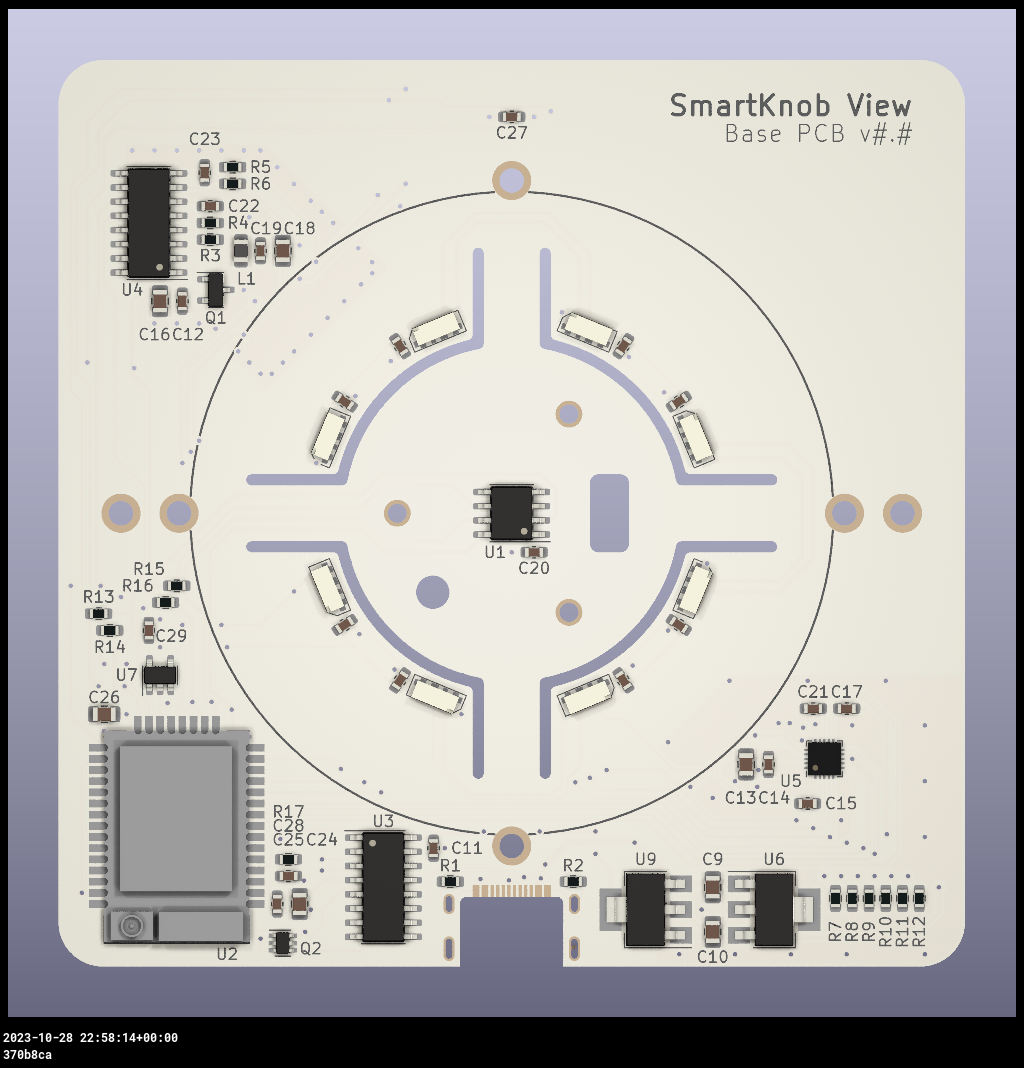
<img src="https://smartknob-artifacts.s3.us-west-1.amazonaws.com/master/electronics/view_base-front-3d.png" width="300" />

<img src="https://smartknob-artifacts.s3.us-west-1.amazonaws.com/master/electronics/view_base-back-3d.png" width="300" />
Ordering notes: use white soldermask, for reflecting light from RGB LED ring around the knob. Should be 1.2mm thick (not "standard" 1.6mm).
Latest auto-generated (untested and likely broken!) artifacts⚠️:
BOM (for JLCPCB assembly (warning: completely untested!)
CPL (for JLCPCB assembly) (warning: completely untested!)
⚠️ For tested/stable/recommended artifacts, use a release instead.
Screen PCB

<img src="https://smartknob-artifacts.s3.us-west-1.amazonaws.com/master/electronics/view_screen-front-3d.png" width="300" />

<img src="https://smartknob-artifacts.s3.us-west-1.amazonaws.com/master/electronics/view_screen-back-3d.png" width="300" />
Ordering notes: Must be 1.2mm thick (not "standard" 1.6mm) per mechanical design.
Latest auto-generated (untested and likely broken!) artifacts⚠️:
⚠️ For tested/stable/recommended artifacts, use a release instead.
SmartKnob Mini
Planned for the future.
Frequently Asked Questions (FAQ)
How much does it cost?
I wish I could tell you now, but I don't actually know off the top of my head. Check back soon - I've only built 1 so far, which was the result of a bunch of tinkering and prototyping over an extended period, so I don't have all the expenses tallied up yet. Certainly less than $200 in parts, and maybe closer to $100?
Does it work with XYZ?
Not yet. So far I've only implemented enough firmware for the demo shown in the video, so you can't actually use it for anything productive yet. The basic detent configuration API is there, but not much else. Lots of firmware work remains to be done. If you build one, I'd love your help adding support for XYZ though!
Can I buy one as a kit or already assembled?
Probably not? Or at least, I don't have any immediate plans to sell them myself. It's not that I don't want you to be happy, but hardware is a hard business and I just work on this stuff in my free time.
It's open source with a fairly permissive license though, so in theory anyone could start offering kits/assemblies. If someone does go down that route of selling them, note that attribution is required (and I wouldn't say no to royalties/tips/thanks if you're in a giving mood 🙂).
General Component Info
Magnetic encoders
MT6701 (MagnTek)
Excellent sensor at a reasonable price - highly recommended. Less noisy than TLV493D, and more responsive (control loop is more stable) using SSI.
- Lots of IO options - SSI, I2C, and ABZ - should offer good response latency
- SSI includes CRC to validate data
- No power-down or low-power options - may not be ideal for battery-powered devices
- Not available from US distributors (Mouser, Digi-Key)
TLV493D (Infineon)
A mediocre choice. Easy to prototype with using Adafruit's QWIIC breakout board.
In my testing, it is a little noisy, requiring filtering/smoothing that can slow responsiveness, hurting control loop stability. Or, with less filtering, the noise can easily be "amplified" by the derivative component in the PID motor torque controller, causing audible (and tactile) humming/buzzing.
There is also apparently a known silicon issue that causes the internal ADC to sometimes completely lock up, requiring a full reset and re-configuration. See section 5.6 in the User Manual
In the Master Controlled Mode (MCM) or the Fast Mode (FM) the ADC conversion may hang up. A hang up can
be detected by:
 - Frame Counter (FRM) counter stucks and does not increment anymore.
In my experience testing 4 different Adafruit breakout boards, 2 of them (50%) regularly exhibit this lockup behavior within a minute or two of use. It is possible to detect and auto-reset (and there is code in the project to do so), but it is slow and may cause undesirable jumps/delays if the sensor locks up often.
AS5600 (AMS)
A mediocre choice. Cheap breakout boards are readily available.
In my testing, it's fairly noisy (anecdotally, noisier than the TLV493d), requiring filtering/smoothing that can slow responsiveness, hurting control loop stability. Additionally, it saturates at a lower magnetic field strength than other sensors I tested, requiring a significant air gap (8-10mm) when used with a strong neodymium diametric magnet like Radial Magnets 8995.
Motor drivers
TMC6300-LA
This is a relatively new IC and it's a perfect match! There generally aren't any other drivers (with integrated fets) that meet the requirements for the low-voltage and low-current motors used in this project (DRV8316 might work, but has not been tested).
Highlights:
- 2-11V DC motor supply input
- Up to 1.2A RMS
- Tiny (3x3mm QFN)
Motors
32mm Rotor, Hollow Shaft, Diametric magnet


- 32mm rotor
- 15mm overall height (including magnet), 12.75mm height w/o magnet, 9mm rotor height
- low/zero cogging - excellent for completely smooth input
- 5.9mm hollow shaft
- built-in diametric magnet for encoder
- Proven option
This is overall the easiest motor to get started with. Low cogging and a built-in diametric magnet are great!
Sadly, does not seem to be available any longer.
Firmware
TODO: document this
Also TODO: implement a lot more of the firmware
Acknowledgements
This project was greatly inspired by Jesse Schoch's video "haptic textures and virtual detents" and the corresponding discussion in the SimpleFOC community. Seriously, this project wouldn't exist if not for that video - thank you Jesse!
License
This project is licensed under Apache v2 (software, electronics, documentation) and Creative Commons Attribution 4.0 (hardware/mechanical) (see LICENSE.txt and Creative Commons).
Copyright 2022 Scott Bezek

Licensed under the Apache License, Version 2.0 (the "License");
you may not use this file except in compliance with the License.
You may obtain a copy of the License at

    http://www.apache.org/licenses/LICENSE-2.0

Unless required by applicable law or agreed to in writing, software
distributed under the License is distributed on an "AS IS" BASIS,
WITHOUT WARRANTIES OR CONDITIONS OF ANY KIND, either express or implied.
See the License for the specific language governing permissions and
limitations under the License.